Power raking and dethatching are two different tools for two different jobs. They get used interchangeably, but in Colorado, choosing the wrong one can stress your lawn at the worst possible time.
What Is Thatch and Why Does It Matter
Thatch is the layer of dead and living organic matter between your grass blades and the soil. It is made up of dead grass stems, roots, and crowns that accumulate faster than they break down. A thin layer under half an inch is fine. It insulates roots and holds some moisture. But once thatch exceeds half an inch, problems start:
- Water pools on the surface instead of soaking in to roots
- Fertilizer and weed control sit in the thatch layer instead of reaching soil
- Disease and insects find ideal habitat in the dense mat
- Roots stay shallow because they grow into the thatch instead of the soil
In Aurora, thatch builds up faster than in many other regions. Clay soil decomposes organic matter slowly. Our dry winters leave dead material in place rather than breaking it down. And Kentucky bluegrass produces a lot of lateral stems that contribute to thatch buildup year over year.
What Power Raking Does
Power raking uses a machine with rapidly spinning vertical blades that cut through and lift out the thatch layer. It is aggressive. The blades penetrate into the thatch and pull it up, leaving behind significant debris to collect and haul away.
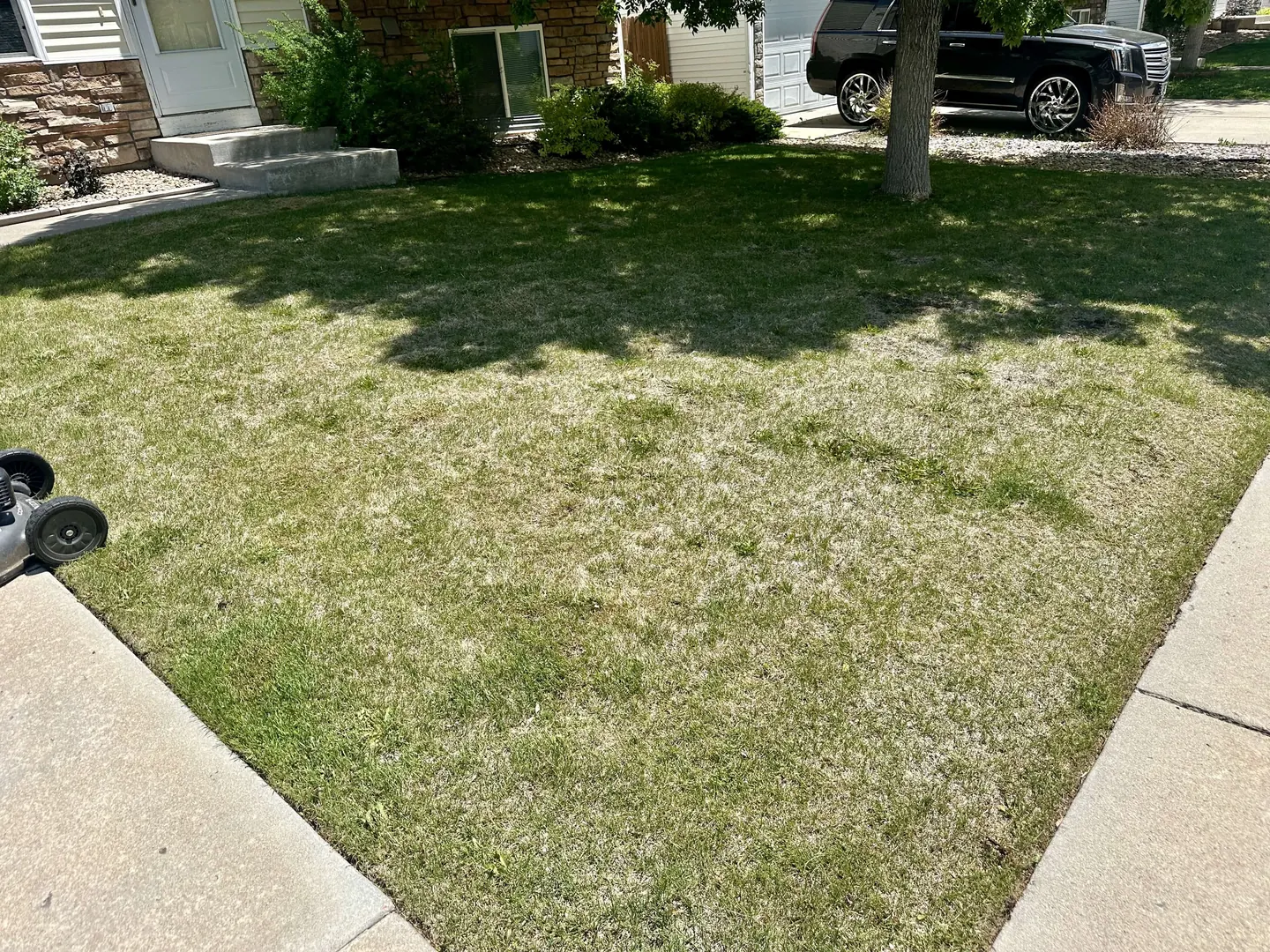
Your lawn will look rough after power raking. That is expected. Within 2 to 3 weeks, the grass comes back thicker because it finally has access to sunlight, water, and nutrients without a dense mat blocking everything.
Power raking is the right choice when:
- Your lawn has not been power raked in two or more years
- Thatch depth is over half an inch (push a screwdriver into the lawn and measure)
- Water puddles on the surface instead of soaking in
- The lawn feels spongy underfoot
- You have visible dead patches and matted areas from winter
What Dethatching Does
Dethatching uses a machine with spring tines, flexible metal fingers that comb through the surface of the lawn. It is lighter work than power raking. The tines pull out loose debris and surface material without penetrating as deeply.
Dethatching is appropriate for light thatch maintenance on a lawn that was power raked the previous year, or for lawns with thin surface thatch where you want to remove debris without disturbing the grass significantly.
Power Raking vs Dethatching: Quick Comparison
Here is how the two services compare for Colorado lawns:
| Power Raking | Dethatching | |
|---|---|---|
| Tool | Rotating blades | Spring tines |
| Depth | Cuts into thatch layer | Combs surface only |
| Aggression | High | Low |
| Recovery time | 2-3 weeks | Minimal |
| Best for | Heavy thatch (0.5"+) | Light maintenance |
| Colorado front range need | Most years | Occasional |
For most Aurora lawns, power raking is the right call every spring or every other spring. Dethatching alone does not do enough on lawns with real thatch problems.
What Power Raking Actually Does to Aurora Clay Soil
This is where it matters specifically for the Front Range. Aurora's heavy clay soil reacts differently to power raking than loamy or sandy soil does.
Clay holds structure tightly. During winter, freeze-thaw cycles compress the top layer further. By spring, Aurora clay is dense and the thatch above it has been through repeated freezing and thawing, making it matted and compacted rather than loose. Spring tines used for dethatching often cannot cut through this properly.
Power raking on Aurora clay:
- Cuts through the compacted thatch mat that spring tines cannot handle
- Creates micro-channels that improve water infiltration into the clay immediately
- Exposes the clay surface to water and fertilizer for the first time since fall
- Pairs directly with aeration: power rake first, then aerate to break subsurface compaction
The risk with Aurora clay is doing it when the soil is still wet. Power raking on soggy clay pulls up healthy grass crowns and can damage soil structure. Wait until daytime temps are consistently above 50 degrees and the soil is dry enough that it does not stick to your shoes.
When to Power Rake in Colorado
The window along the Front Range is late March through mid-April. You want:
- Soil thawed and dried from spring snowmelt
- Grass starting to green up but not in full active growth
- Daytime temps consistently above 50 degrees Fahrenheit
- Before pre-emergent weed control application
Power raking too early (while soil is still frozen underneath) tears up roots. Too late (May or later) stresses the lawn right when it needs energy for the growing season.
Common questions
Power raking is the right choice for most Aurora lawns.
- Colorado bluegrass builds thatch faster than it breaks down in clay soil.
- If your lawn has not been power raked in two or more years, feels spongy underfoot, or has water that puddles instead of soaking in, you need power raking, not light dethatching.
Two to three weeks in Aurora spring conditions.
- Your lawn looks rough immediately after, brown and torn up.
- New growth fills in quickly once it has access to sunlight, water, and nutrients without the thatch barrier.
- Most homeowners are surprised at how fast recovery happens once that layer is gone.
Late March through mid-April along the Front Range.
- You want soil thawed and dried from snowmelt, grass starting to green up but not in full active growth, and daytime temps consistently above 50 degrees.
- Power raking on wet or frozen Aurora clay tears up healthy roots and does more damage than the thatch itself.
Push a screwdriver into the lawn between soil and the green growth.
- Anything over half an inch is thatch worth removing.
- Three quarters of an inch or more means you need power raking, not light dethatching.
- You can check any spot in the yard this way in about 10 seconds.